6 min read
How to read your birth chart
A natal chart looks like a wiring diagram and reads like a language. Here's the grammar — planets, signs, houses, aspects — and the order to read them in.
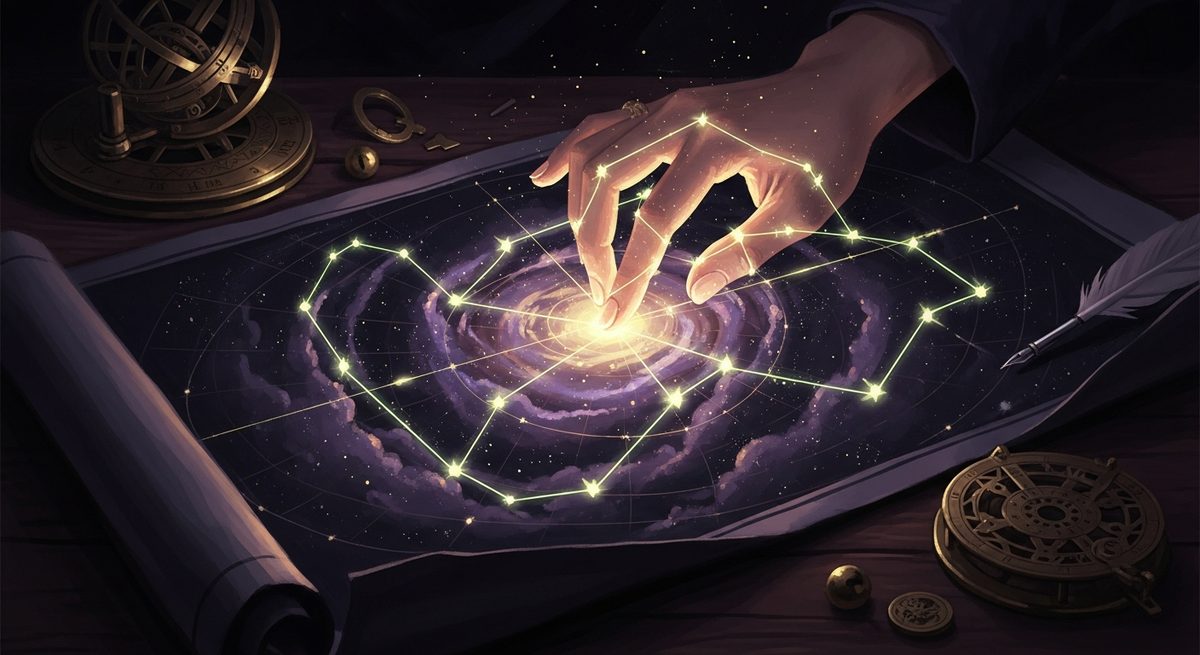
A birth chart is a map of the sky from one specific place, at one specific minute: the moment you arrived. Every planet had a position, and the whole thing was rotating, which is why the time and the city matter as much as the date.
It looks intimidating — a wheel, some glyphs, a lot of lines. But it's built from four moving parts, and once you have those, it reads.
1. Planets — what
The planets are the actors. Sun: identity and direction. Moon: needs and instincts. Mercury: how you think and speak. Venus: what you value and how you love. Mars: how you want and how you fight.
Then the slow ones, which describe the weather of a whole era of your life rather than a personal quirk. Jupiter: growth and appetite. Saturn: limits and mastery. Uranus, Neptune and Pluto move so slowly that your whole generation shares them — they matter personally mainly through the house they sit in and the aspects they make.
2. Signs — how
The sign a planet sits in describes its style, not its job. Mars is desire either way; Mars in Aries wants directly and immediately, Mars in Libra wants to be wanted back and hesitates to make the first move. Same actor, different accent.
3. Houses — where
The twelve houses are areas of life: self, money, communication, home, creativity, work and health, partnership, depth and transformation, meaning, career, community, and the hidden interior.
Houses are what your birth time buys you. The wheel turns roughly one degree every four minutes — get the time wrong by an hour and the whole house structure shifts, along with your rising sign. It's the single most common reason a chart "doesn't feel right".
Planet is what. Sign is how. House is where. Aspect is the argument between them.
4. Aspects — the tension
Aspects are angles between planets, and they're where a chart stops being a list and becomes a person.
A conjunction (0°) fuses two drives together. An opposition (180°) puts them at either end of a see-saw — you tend to swing. A square (90°) is friction, and it's productive: squares are where people actually develop, because something has to be resolved. Trines (120°) and sextiles (60°) are ease — talent that arrives so naturally you may not notice you have it.
The tighter the angle, the louder it is. An aspect within a degree is a defining feature of a life. One at seven degrees is background noise.
The order to read in
Don't start at the top and work round — you'll drown. Start with the Sun, Moon and rising together: identity, interior, and the front door. Then the chart ruler — the planet that rules your rising sign — and wherever it sits, because it carries the whole chart's flavour. Then find the tightest aspects and the planets sitting on the angles. Those are the loud ones.
Only then fill in the rest. A chart isn't a list of traits; it's a set of tensions. The reading is the synthesis — noticing that your Saturn is sitting on the thing your Moon most needs, and saying what that's actually like to live with.
And then there's now
The natal chart is the instrument. What's playing today is the transits: where the planets are right now, and what they're touching in your chart. That's why a real reading feels timely rather than generic — it's the difference between describing your nature and describing your week.
Want to hear yours?
Sibyl reads your actual chart aloud — and what's pressing on it today. Casting your chart is free.
Call your SibylFor entertainment purposes only.